
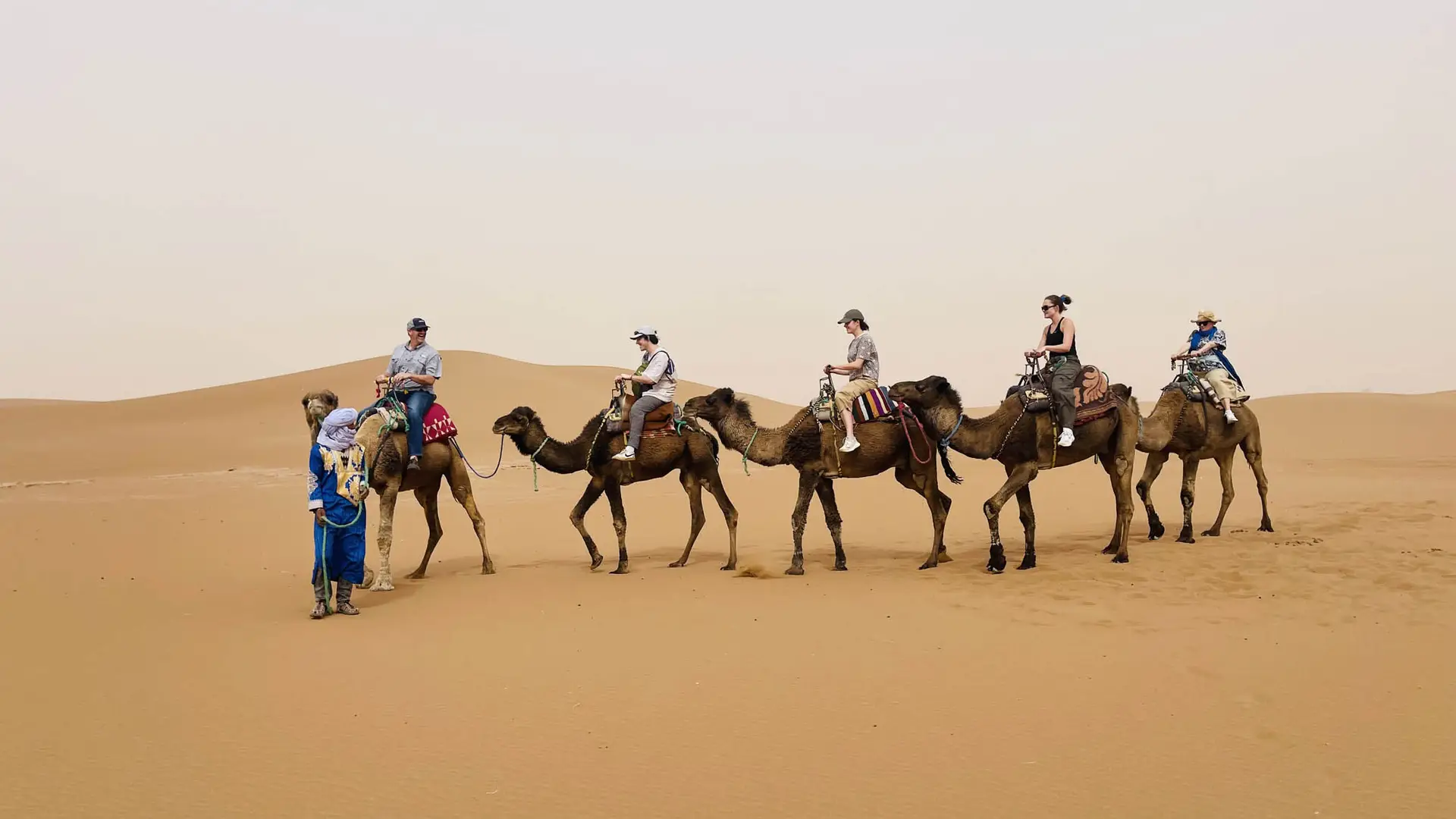
Multi-day camel treks
Camel trekking in the Erg Chigaga dunes
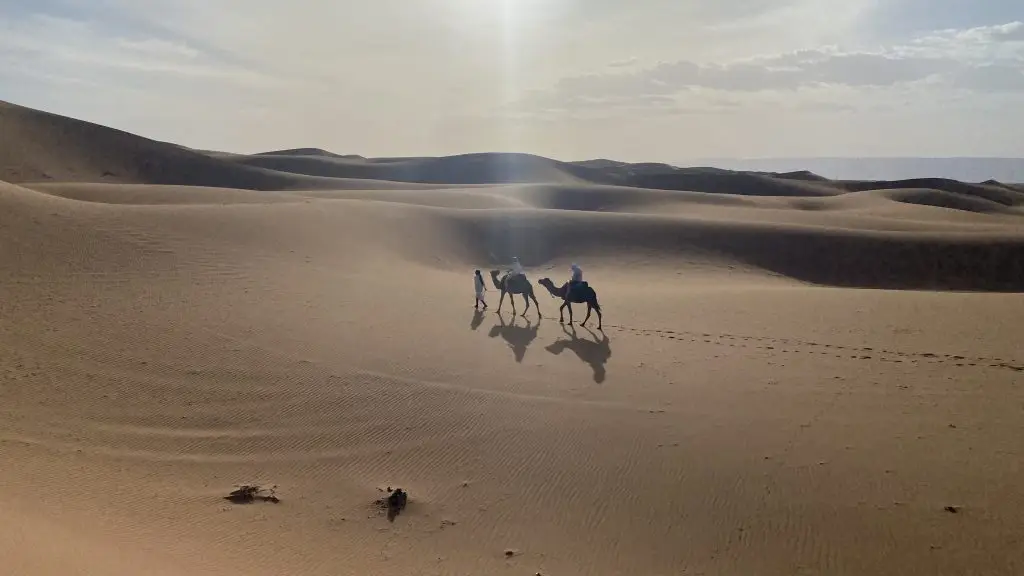
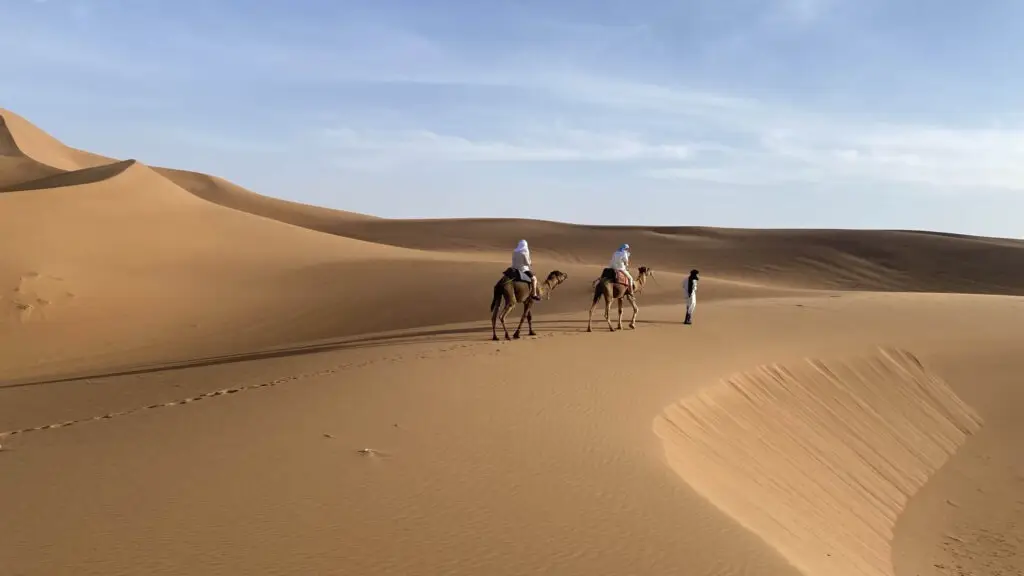
Camel trekking is the slowest and quietest way to cross the Sahara. Nothing moves faster than a walking camel, so the dunes, the light and the silence set the pace of your days.
We arrange camel trekking in Erg Chigaga in five lengths: 3, 5, 7, 9 and 11 days. Every trek is planned with you in advance, so the route, the pace and the nights in the desert fit your dates, your group and the season.
This page helps you choose a length and shows how a quote works. We do not publish a fixed price list, because routes and prices are agreed for each trek.
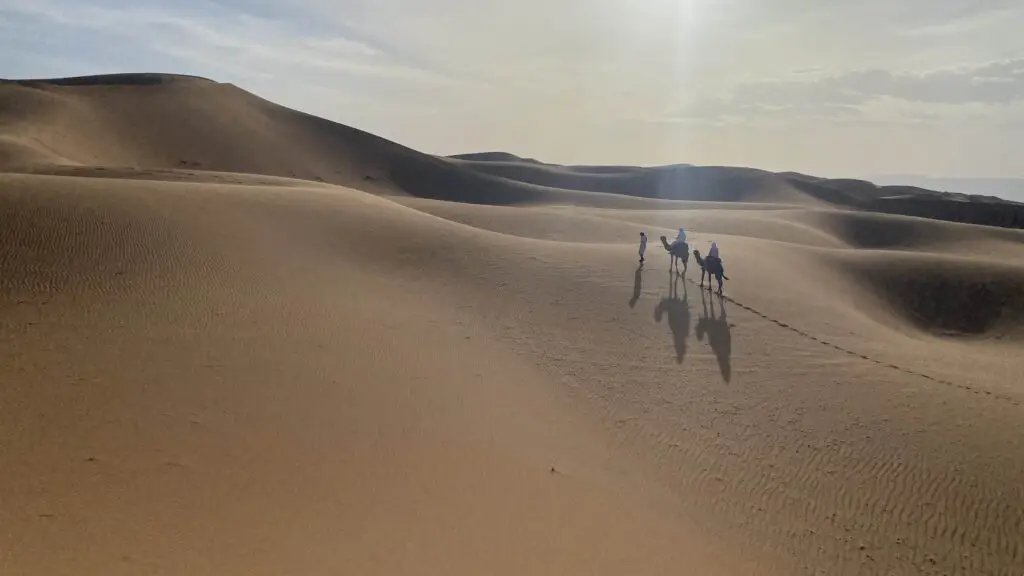
On this page
The essentials
Camel trekking in Erg Chigaga at a glance
The key facts you need to decide whether a camel trek suits your trip.
| Topic | What to know |
|---|---|
| Where | The Erg Chigaga dunes in the Draa region, about 56 km south-west of the oasis town of M’Hamid El Ghizlane (Wikipedia). |
| Trek lengths | 3, 5, 7, 9 or 11 days. |
| Who it is for | Couples, families, small groups and travellers who want a journey arranged for their own group. |
| Season | Our season runs from September 1 to June 15. We close in summer, when desert temperatures pass 50°C, so plan your camel trekking inside that window. |
| Price | Agreed for each trek and shown in your written quote. Camp stays start from $90 per person per night with breakfast and dinner. |
| Booking | A quote is not a booking. We confirm a booking to you in writing. |
| Languages | English, French and Arabic. |
| Mobile signal | There is none at the camp. Plan to be offline, and share your arrival plans with us before you travel. |
Choose your length
Choose your camel trekking length: 3, 5, 7, 9 or 11 days
Each length gives a different experience. Pick the one that fits your time and energy, and we will shape the route around it.
3 days
3-day camel trek
The shortest option and the easiest to fit into a wider Morocco trip. Three days is long enough to settle into the rhythm of camel travel without taking a full week out of your holiday.
Suits: first-time trekkers, couples on a short stay and travellers adding a trek to a longer itinerary.
5 days
5-day camel trek
A balanced journey. Five days gives a steady rhythm of riding and rest, with time for the landscape to change around you.
Suits: couples and small groups who want a proper journey without giving up a full week.
7 days
7-day camel trek
A full week in the desert. Seven days suits travellers who want to disconnect properly and can set aside a week for it.
Suits: small groups and families who are comfortable with long days outdoors.
9 days
9-day camel trek
An extended journey. Nine days is a serious commitment of time and energy, so it suits people who already know they enjoy long days outdoors.
Suits: keen trekkers, adventure travellers and repeat visitors.
11 days
11-day camel trek
The longest option, closer to an expedition. Eleven days gives the most time at camel pace.
Suits: desert enthusiasts and adventure travellers with plenty of time.
Not sure which length?
Tell us your dates and how you like to travel. We will suggest a length and explain the trade-offs, with no obligation.
Route, daily riding time, overnight arrangements and price are agreed in your written quote.
A simple way to choose your camel trekking length is to count the days you can fully set aside, then subtract the days you need to reach the dunes and travel home. A 3-day trek fits most short stays. Seven, nine or eleven days only make sense if you can keep a whole week or more free for the desert, and if you already know you enjoy long days outdoors. If your plans are still open, tell us your dates and we will suggest a length, with the trade-offs explained.
How it works
How we plan your camel trekking journey
A good camel trek starts with a conversation. Because every group is different, we plan each journey with you in five simple steps.
- Tell us your plans. Send your dates, group size and the length you have in mind, or ask us to help you choose.
- We propose the trek. We reply with a route and a price for your group, and we answer your questions.
- We confirm in writing. Your booking is confirmed only when we confirm it to you in writing, by email or message.
- You share your arrival plans. The last 60 km to the camp is by 4WD and there is no mobile signal, so we agree the details before you travel.
- You set off at camel pace. We confirm the starting point and the timing with you in advance.
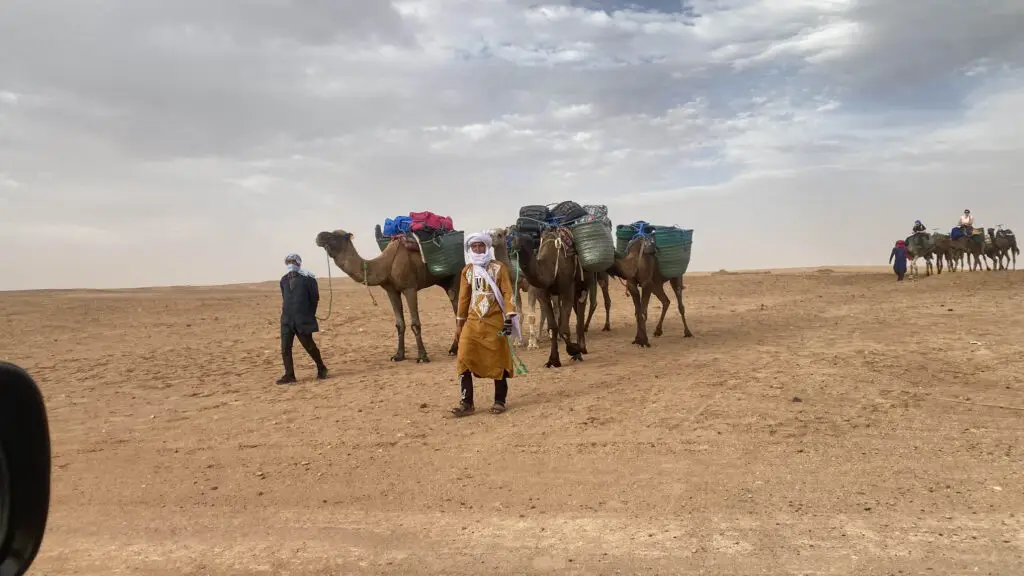
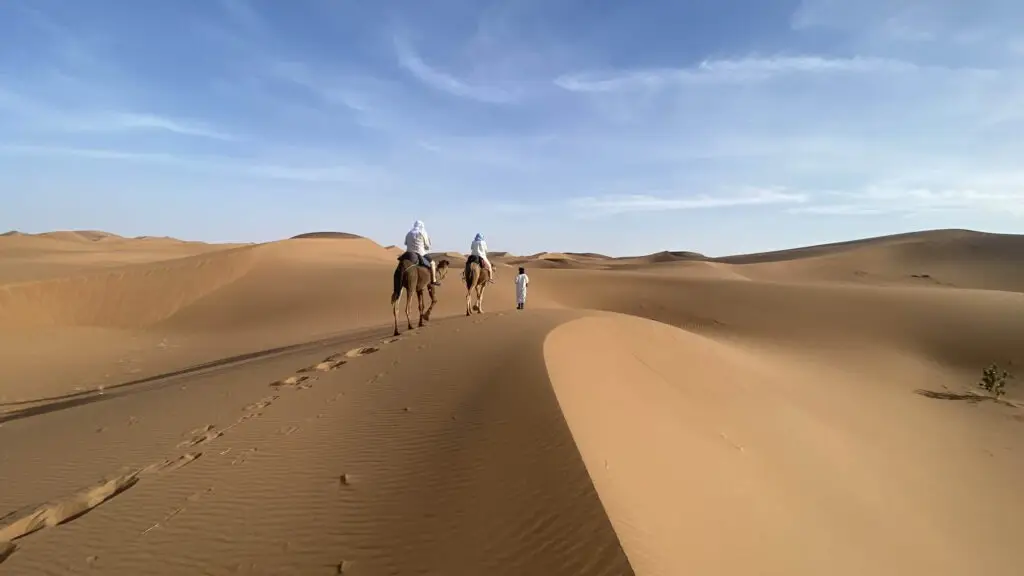
Plan ahead
What to know before your camel trekking journey
Erg Chigaga is remote on purpose. A little planning makes the trip easier and safer.
Season and temperatures
October to April is the most comfortable, with daytime highs of roughly 18–29°C. September, May and June are noticeably hotter. See the month-by-month guide.
Getting there
The last 60 km from M’Hamid is by 4WD and takes two hours or more. Read how to get to Erg Chigaga before you book flights.
Fitness and health
Camel riding involves physical effort and some risk. Tell us about your fitness, any health condition, mobility limit or allergy, and follow your guides’ instructions.
Respect for the desert
We carry rubbish out of the dunes and keep to the paths our guides suggest. We ask every guest to do the same.
Staying in touch
There is no mobile signal at the camp. Tell family where you will be and agree check-in times before you leave the last town.
Insurance
Check that your travel insurance covers camel riding and remote travel before you book.
Packing list
What to pack for camel trekking in the Sahara
Light, layered and simple works best. This is general advice. Your written quote says what is provided on your trek, so ask before you buy anything new.
Clothing and sun protection
- Loose, breathable long sleeves and trousers, which protect your skin from sun, sand and the saddle.
- Warm layers for the evenings. From December to February the average night-time low is about 7–9°C.
- A wide-brimmed hat and a scarf or cotton headcloth for sun and blowing sand.
- Sunglasses, high-factor sunscreen and lip balm.
- Closed, comfortable shoes that you can walk in on soft sand.
Small essentials
- A small daypack and a reusable water bottle.
- A headtorch with spare batteries, because there is no street lighting in the dunes.
- Any personal medication, plus basic first-aid items such as plasters and blister cream.
- A power bank. There is no mobile signal, and charging points may be limited.
- Wet wipes, tissues and a few small bags to carry your rubbish out of the desert.
Pack for the month you travel. The best time to visit Erg Chigaga guide shows average daytime highs and night-time lows month by month, so you can judge how many warm layers you need. If you are unsure about anything on your list, ask us when you request your quote and we will tell you what to bring.
Get ready
How to prepare for long days of camel trekking
Camel trekking is gentle compared with many adventure trips, but the days are long and the saddle can tire you. A little preparation makes the first days far more comfortable.
- Build basic fitness. Regular walking, plus some leg and core exercises, helps with balance and stamina in the saddle.
- Stretch. Hips, thighs and lower back take the strain when you ride for hours, so stretch before and after each day.
- Drink early and often. Dry desert air hides how much you sweat. Sip water through the day instead of waiting until you are thirsty.
- Break in your clothes and shoes. Wear new trousers and shoes before you travel so that nothing rubs on day one.
- Choose a length you can enjoy. If you have never ridden a camel, a shorter trek is a sensible start, and you can always come back for a longer one.
- Tell us about your health. Share any condition, injury or allergy so that we can plan the pace with you.
Not sure how your group will cope with several days at camel pace? Say so when you ask for your quote. We would rather suggest a shorter trek that your whole group enjoys than a long one that tires everyone.
Before or after your trek
Combine camel trekking with a camp stay
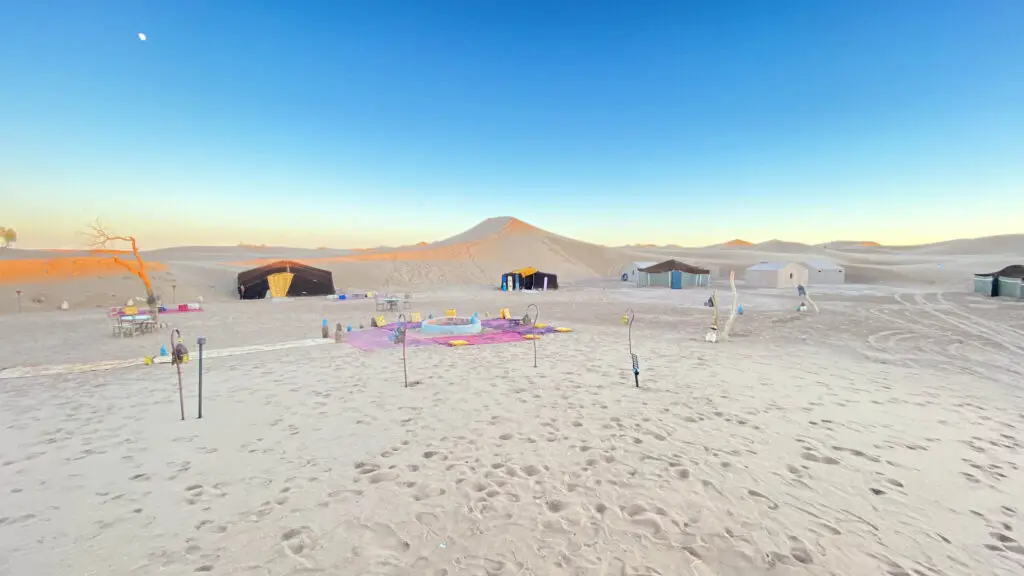
You can add nights at one of our four camps before or after your trek. All four are in the Erg Chigaga dunes.
- Main Camp: eight traditional nomad tents with a shared shower and toilet block.
- Luxury Camp: five ensuite tents of 36 m².
- Private Camp: four ensuite tents for families or friends.
- Mobile Camp: a single tent for two, which is also an exclusive base for treks to the main camp.
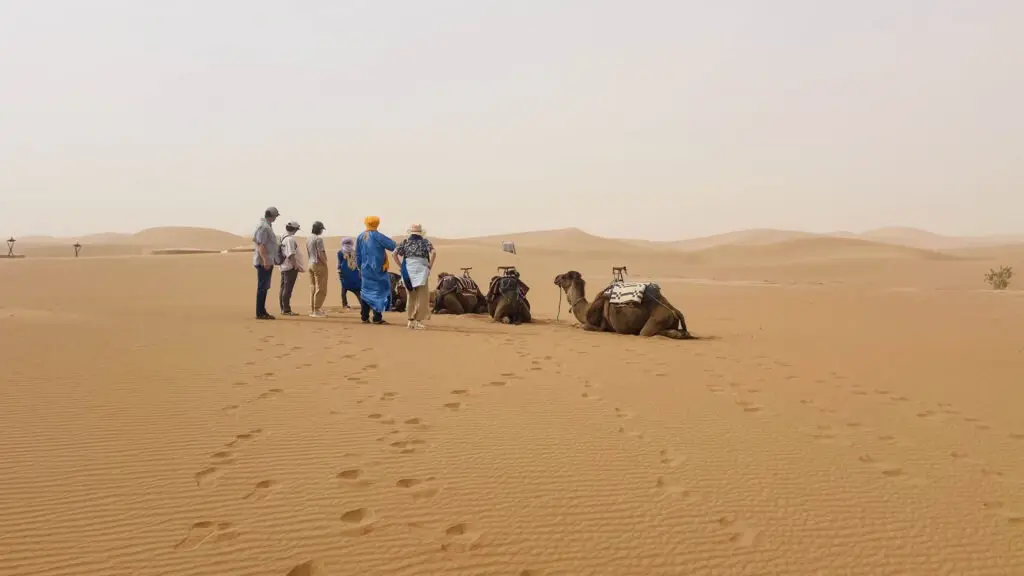
If you only want a shorter ride, camel rides at sunrise or sunset are an optional extra for guests at the camp. Compare the camps or see all activities and what is included.
Book with confidence
Questions to ask before booking camel trekking
Whoever you trek with, ask these questions first. We answer all of them in writing in your quote.
About the journey
- How many hours will we ride each day?
- Where does the trek start and finish?
- How is luggage carried?
- What is the plan if the weather or the track changes?
About the arrangements
- Where will we sleep, and what is provided?
- What are the meals, water and drinks arrangements?
- What does the price include and exclude?
- What are the payment and cancellation conditions?
Who looks after you
Why go camel trekking with a local Berber team
Our team come from local Berber families who know the dunes, the tracks and the weather. The camp keeps its own camels.
We follow simple rules in the desert: nothing is left behind, we keep to sensible paths, and Berber elders guide how we work. Read more about us and our approach.
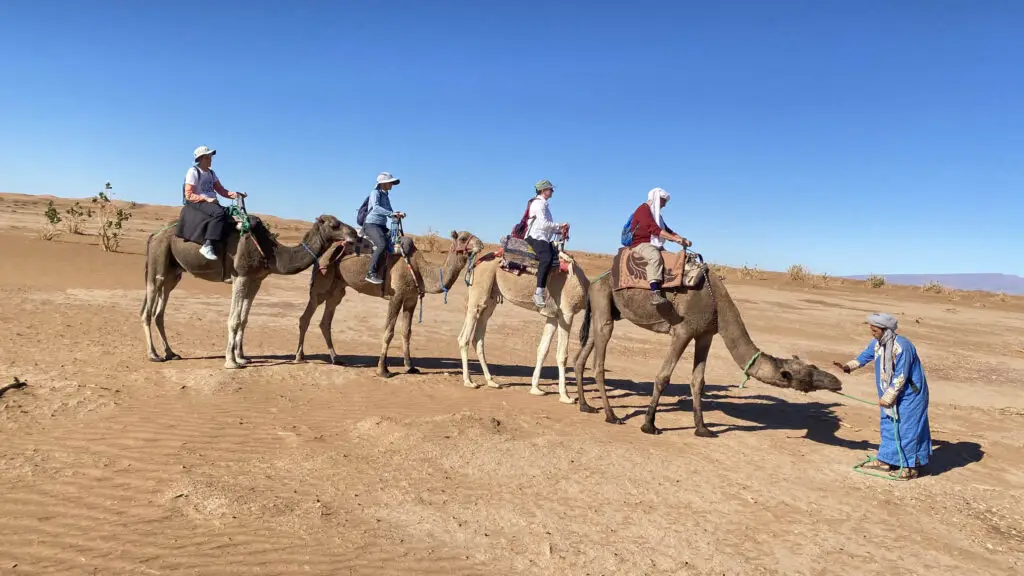
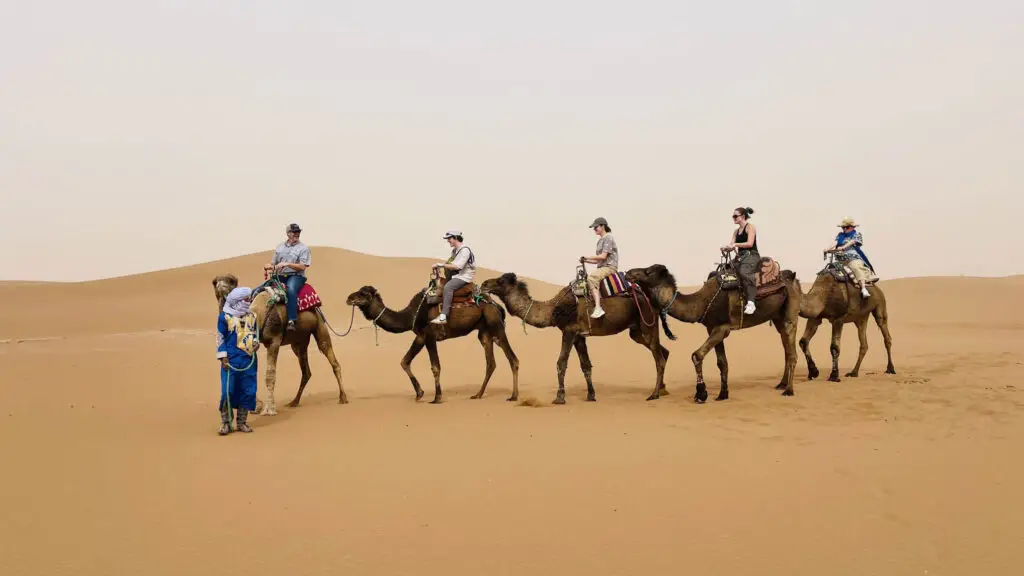
Camels used for desert travel are dromedaries, the one-humped species (Wikipedia). They have long been used to carry riders and packs across the desert, and their steady walk sets the pace of a camel trek.
A dromedary stores fat in its single hump, not water, and it copes with heat and scarce water better than most animals. Its broad, padded feet spread its weight on soft sand, and long eyelashes and nostrils that can close help to keep sand out. Camels are working animals with their own temperament, so approach them calmly and let the handler guide you when you mount and dismount.
Quick answers
Camel trekking FAQ
How long should my camel trekking journey be?
Choose the time you can comfortably give. Three days suits a short stay, five days a balanced journey and seven days a full week. Nine or eleven days suit travellers who love long days outdoors. If you are unsure, tell us your dates and we will suggest a length.
Do I need experience for camel trekking?
Tell us about your experience, your fitness and any health condition. We plan the pace and the length around your group. Camel riding involves physical effort and some risk, so please follow your guides’ instructions.
When is the best time for camel trekking in Erg Chigaga?
Our camp is open from September 1 to June 15. October to April is the most comfortable, with daytime highs of roughly 18–29°C, and September, May and June are hotter. See the best time to visit Erg Chigaga.
How much does camel trekking cost?
Prices are agreed for each trek. They depend on the length, the season and the size of your group, and they appear in your written quote. For reference, camp stays start from $90 per person per night with breakfast and dinner. See the camp prices.
Can children join a camel trek?
Tell us the ages of everyone travelling and we will advise whether a trek suits your family and which length to choose.
Can I combine camel trekking with a camp stay?
Yes. You can stay at any of our four camps before or after a trek. The Private Nomadic Mobile Camp is also an exclusive base for treks to the main camp.
What is included in a camel trek?
The inclusions are listed in your written quote, so you see exactly what you pay for. For camp stays, breakfast and dinner are included, while lunch and drinks cost extra.
What should I wear for camel trekking?
Wear loose, breathable long sleeves and trousers, a hat and a scarf for the sun and the sand, closed shoes and warm layers for the evenings. The full packing list is above, and your quote tells you what is provided on your trek.
Is camel trekking safe?
Camel riding involves physical effort and some risk. Please follow your guides’ instructions, tell us about any health condition, mobility limit or allergy before you travel, and check that your travel insurance covers camel riding and remote travel.
What happens if the weather or the track changes?
Desert weather and track conditions can change timings. If safety, weather or road conditions force us to change your plans, we contact you as soon as we can to discuss the options. Ask us in your quote how a change of plan would work on your trek.
Will I have a mobile signal?
There is no mobile signal at the camp. Plan to be offline during your trek, and share your arrival plans with us before you travel.
Free quote
Ask for your camel trekking quote
Tell us your dates, who is travelling and the trek length that interests you. We reply by email or WhatsApp in English, French and Arabic. A quote is not a booking, and we never ask for payment details through the website.
- LocationErg Chigaga, near Zagora, MoroccoOpen in Google Maps
- Phone+212 669 929 087Monday to Saturday, 9 am to 8 pm
- WhatsAppSend us a messageSame number as the phone line
- EmailContact@sahara-desert-camp.comWe answer in English, French and Arabic
Looking for a wider Morocco itinerary? See our Morocco private desert tours.